The hedge fund manager is seeing ‘real evidence’ of improvement in two of the country’s most pressing issues.
Peregrine Capital has been increasing its long exposure to South African equities. The hedge fund manager believes that the opportunity in local shares, particularly SA Inc counters, is being heavily underestimated by the market.
Analyst AJ Snyman said at the Meet the Managers event that uncertainty in South Africa had been especially high over the last six to eight months. The unsettled global backdrop together with a persistently weak South African economy, load shedding, the issues at Transnet and ‘massive election risk’ had severely dampened investor appetite for the local market.
‘Most investors think the future doesn’t look all that pretty,’ Snyman said.
However, Peregrine has been doing extensive research and analysis on two of the country’s most acute problems and has found reasons for optimism.
‘We believe that even though Eskom and Transnet are still concerns, there is real evidence to suggest things are improving,’ Snyman said. ‘These two factors have resulted in extremely negative sentiment towards SA equities and therefore very low valuations.
‘But we have been proponents of buying SA equities and have done that ourselves, because we think there are reasons to think the future will be better.’
Lights on
At Eskom particularly, Peregrine has found a number of reasons to be positive about the trajectory.
‘For last year or so we have been saying that towards the end of 2024 and into 2025 load shedding as we know it will be a thing of the past,’ Snyman said. ‘We have done a substantial amount of our own work, and constructed our own model of electricity supply and demand. We have also spoken to experts, whether at Eskom or in the industry in general.
‘And basically, from all work we did, we believe there is real evidence that load shedding will be something of the past in near future.’
Firstly, he said that the turnaround plan at Eskom is starting to take effect, particularly in terms of planned maintenance.
‘Under previous CEO André de Ruyter, they had apparently tried to perform all maintenance in-house, but because they had lost skills, they couldn’t do it,’ Snyman said. ‘But now they are starting to bring back those skills through consulting and outsourcing.
‘But more than that, they are bringing in the original equipment manufacturers to do the maintenance alongside Eskom. They have the specialist skills and knowledge required for this.’
Incentives
He added that they have also worked on incentivising everyone at a station level correctly to make sure that maintenance gets done and unplanned outages are kept to a minimum.
Secondly, a significant amount of supply has now come back online. That has had a noticeable impact.
Lastly, there has been a significant investment in renewable energy with notable effects.
‘In April there was cold snap, and despite that we didn’t have load shedding,’ Snyman said. ‘On that day, renewables generated 3000MW alone. That shows that renewables are taking strain off the grid.’
All of this is evidenced in the fact that unplanned outages have dropped substantially over the past year. And this is not because Eskom is burning huge amounts of diesel in its open cycle gas turbines. In fact, their usage has also fallen noticeably.
 Source: Peregrine Capital
‘So, the improvement is real,’ Snyman said. ‘We’re not saying there won’t be load shedding in the next few months. But, at most, we think we will only see stage one or stage two during winter.’
While he said that Transnet was ‘a different kettle of fish’, Snyman said that there are also clear improvements taking place there.
‘I’m not going to pretend it’s on the same trajectory as Eskom, but there has been an earlier recognition by government of what the issues are, and a willingness from government to engage the private sector.’
He pointed out that there had been a change of leadership at Transnet, steps have been taken to fix the balance sheet, and there are moves towards some measure of privatisation.
‘It will be a multi-year story, but at least we’re moving in the right direction,’ Snyman said.
And, in his view, these developments were significant for the South African equity market.
‘Eskom and Transnet, among some other things, have led to extreme negative sentiment towards South Africa as investment destination,’ Snyman said.
The average allocation to local equities in South African balanced funds had decreased from over 45% in the second half of 2021 to close to 30% at the end of March this year.
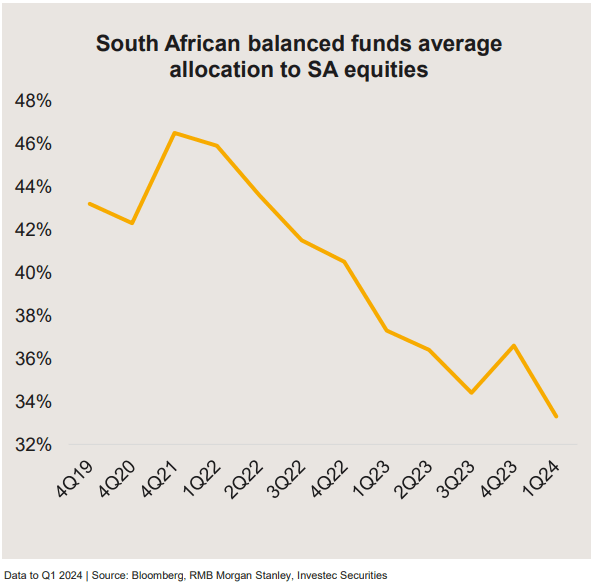
‘The changes to Regulation 28 have definitely played into this, but it shows how negative local managers have been on SA equities,’ Snyman said. ‘Foreigners have also been sellers, and the rate of outflows has increased.
‘This negative sentiment has manifested in extremely cheap valuations of SA shares. Before we had a little rally recently, we had banks trading on five or six times earnings, and dividend yields of 10%.’
He said that there is an incredible opportunity to buy select shares at these kinds of levels, when there is good reason to expect an improvement in the backdrop.
‘When everything around you is moving a certain direction and shouting a certain narrative, it’s difficult to be clear in your head,’ Snyman said. ‘But, sometimes, when that happens, we’ve learned the importance of contrarian thinking and that it’s worth doing the complete opposite of what you feel.’